Incident and Delay Information
Information about incidents and performance degradation of AmiVoice API is provided on the following Statuspage. This section introduces this Statuspage.
Overview
The Statuspage aggregates and provides information on current incidents, service-specific incident information, and detailed performance information for each engine. It also has a feature to send email notifications to registered addresses in case of incidents or performance degradation, and these text notifications are also posted.
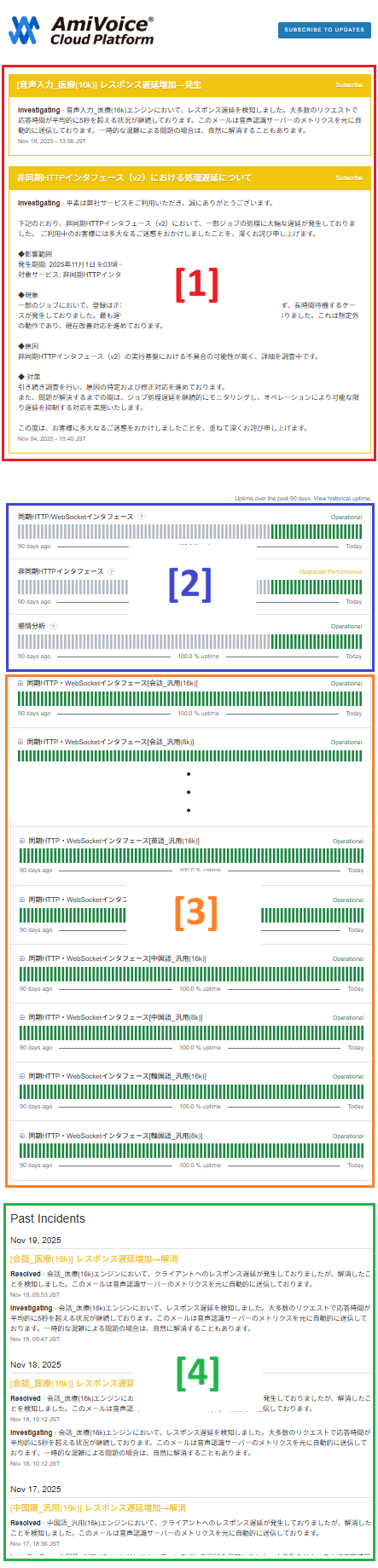
The numbers [1] to [4] in the following screenshot correspond to the numbers listed in the item names in the explanation below.
Types of Service Statuses
On the Statuspage, the status of services is represented by the following statuses:
- Operational - Normal operation: No issues
- Degraded Performance - Performance degradation: Operating but experiencing delays, etc.
- Partial Outage - Partial stoppage: Some functions are unavailable
- Major Outage - Large-scale stoppage: Service is unavailable
- Under Maintenance - Undergoing maintenance: Planned maintenance work in progress
Types of Incident Statuses
On the Statuspage, the status of incidents is represented by the following statuses:
- Investigating - Under investigation: The problem has been confirmed, but the cause and scope of impact are being investigated
- Identified - Identified: The cause of the problem has been identified and response has begun
- Monitoring - Under monitoring: The problem has been resolved and normal operation is being monitored
- Resolved - Resolved: The problem has been resolved
Information Details
Currently Occurring Incidents [1]
Information about currently occurring incidents is posted. In addition to content similar to the incident information posted on the news page (https://acp.amivoice.com/en/news/), performance degradation from the Detailed Information by Engine is also posted. The former is also reflected in the Incident Occurrence Status by Service.
Types of Service Statuses and Colors
The color of the displayed box differs depending on the type of service status.
- Operational - Normal operation: Green (when all services are applicable)
- Degraded Performance - Performance degradation: Yellow
- Partial Outage - Partial stoppage: Brown
- Major Outage - Large-scale stoppage: Red
- Under Maintenance - Undergoing maintenance: Blue
Incident Occurrence Status by Service [2]
The incident occurrence status for three types - Synchronous HTTP interface and WebSocket interface, Asynchronous HTTP interface, and sentiment analysis - is visually displayed. Each colored bar (green, red, etc.) represents the status for one day, and you can check the status for each day over the past 90 days including today. When you hover the mouse cursor over a bar, the details for that day are displayed. If you want to check information from more than 90 days ago, please click on View historical uptime in the upper right.
Meaning of Bar Colors
The color of the bars changes as follows depending on the duration of Partial Outage or Major Outage that occurred on that day. However, Partial Outage is calculated with a factor of 0.3. Degraded Performance and Under Maintenance are not considered.
- 0 minutes: Green
- 1 to 20 minutes: Yellow-green to yellow
- 20 to 40 minutes: Yellow to orange
- 40 to 60 minutes: Orange to red
- 60 minutes or more: Red
The bar colors and uptime rates displayed on the Statuspage are reference information calculated based on the component statuses on the Statuspage. They differ in scope and calculation method from the service uptime rate and the refund determination defined in the AmiVoice API SLA. For the SLA, please see "AmiVoice API SLA".
Current Status
The current status of each service is displayed in the upper right of the bar sequence. For the types of statuses displayed, please see Types of Service Statuses.
Detailed Information by Engine [3]
Detailed information for each engine, automatically detected from sources such as AmiVoice API server logs, is visually displayed. It mainly represents performance status and whether a partial stoppage is occurring. Each colored bar (green, red, etc.) represents the status for one day, and you can check the status for each day over the past 90 days including today. When you hover the mouse cursor over a bar, the details for that day are displayed.
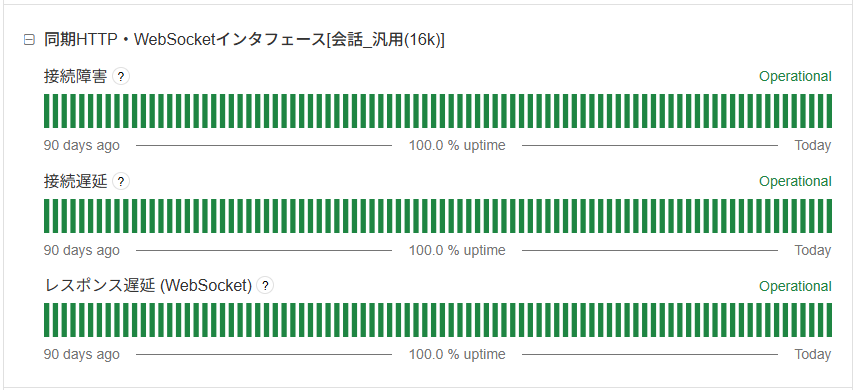
Clicking on the area where the engine name is displayed will open the details. The status is similarly displayed with bars for "接続障害" (Connection Failure), "接続遅延" (Connection Delay), and "レスポンス遅延(WebSocket)" (Response Delay (WebSocket)) respectively.
For the detection criteria for each, please see Anomaly Detection Criteria, and for the colors of each bar, please see Meaning of Bar Colors. If you want to check information from more than 90 days ago, please click on View historical uptime in the upper right of the Incident Occurrence Status by Service.
- For hybrid engines, the speech recognition engine that performs processing differs between when the audio sampling rate is 8k and when it is 16k. Therefore, in "Detailed Information by Engine", even under the same engine name, information is posted separately for the 8k engine and the 16k engine. For example, for the "会話_汎用" engine, it is possible that a failure is occurring at 8k but not at 16k.
- For End to End engines, processing is performed by the same speech recognition engine whether the audio sampling rate is 8k or 16k. Therefore, in "Detailed Information by Engine", unlike hybrid engines, it is not divided into 8k and 16k, and the same information is posted for both sampling rates. For example, if a failure occurs in the "日本語E2E_汎用" engine, it applies whether the audio sampling rate is 8k or 16k.
Anomaly Detection Criteria
The anomalies posted in the detailed information by engine are automatically detected for each engine based on the following criteria.
Each detection criterion may be changed without notice.
Connection Failure
For connection failures, partial outages are automatically detected from the results of periodically executed tests and from AmiVoice API server logs.
- Periodically executed test: Using the Synchronous HTTP and WebSocket interfaces in the same way as an AmiVoice API client, an automated test that sends short test audio and checks whether the correct result is obtained is performed. This test is run for each engine every 15 minutes, and if it fails to obtain the correct result, it is run again 5 minutes later. If the retest also fails, a partial outage (
Partial Outage) is detected. Note that in this state, the details displayed when you hover the mouse cursor over that day's bar describe what kind of anomaly was detected. - Server logs: Detected when internal server communication errors during request processing for the engine in question occur 10 times or more in the last 1 minute.
Connection Delay
Connection delays are automatically detected for each engine from AmiVoice API server logs based on the following criteria.
- When the time taken to connect to the engine in question is 5 seconds or more for 5% or more of requests in the last 1 minute
Response Delay (WebSocket)
Response delays on the WebSocket interface are automatically detected for each engine from AmiVoice API server logs based on the following criteria.
- When the average response time for sessions where recognition results were returned per speech segment for the engine in question, excluding the 5% with the slowest responses, is 5 seconds or more continuously for the last 5 minutes. Note that requests where the response was slow due to client-side factors, such as when the quality of the audio data was significantly poor and speech recognition processing took time, may also have an impact.
Current Status
The current status of each engine is displayed in the upper right of the bar sequence. For the types of statuses displayed, please see Types of Service Statuses.
Past Incidents [4]
A history of incidents and performance degradations that have occurred in the past is posted up to 14 days (2 weeks) ago. The color of the displayed text differs depending on the type of incident, etc. For the correspondence between types and colors, please see Types of Service Statuses and Colors. If you want to check the history from further in the past, please click on Incident History at the bottom.
Email Notifications
You can receive notifications from the Statuspage via email. Notification emails are sent from acp-status@m00.advanced-media.co.jp.
Note that while the notification emails are expressed as a "subscription" in the system, no additional fees are incurred for using the notification emails. (Only basic communication costs apply)
Notification Email Destination
The destination for notification emails is the email address registered as the "Failure Notification Contact Information Email Address" under "Alternative Contact Information Email Address" on the MyPage.
To receive notification emails, you need to complete an approval process. When a new account is registered, you will receive an email with the subject "[AmiVoice API status] Confirm your subscription". Clicking the "Confirm Subscription" button in this email will activate the subscription (reception) of notification emails. Note that if the same email address is already registered for notification email subscription with another account, you cannot register it again.
Notification Content
In notification emails, you can receive the following notifications:
- Occurrence information for Currently Occurring Incidents (including updates)
- Occurrence information for performance status degradation posted in Detailed Information by Engine (including updates)
How to Unsubscribe from Notification Emails
You can unsubscribe by deleting the "Failure Notification Contact Information Email Address" in the "Alternative Contact Information Email Address" section on MyPage, or by clicking the "Unsubscribe" link in the received notification email.